Filing an ECHR application is not a standard court procedure. The Court has its own rules, its own forms, and a strict admissibility filter that eliminates most cases before they are ever examined. The guide below covers what you need to do, in the right order, before the Registry even processes your file.
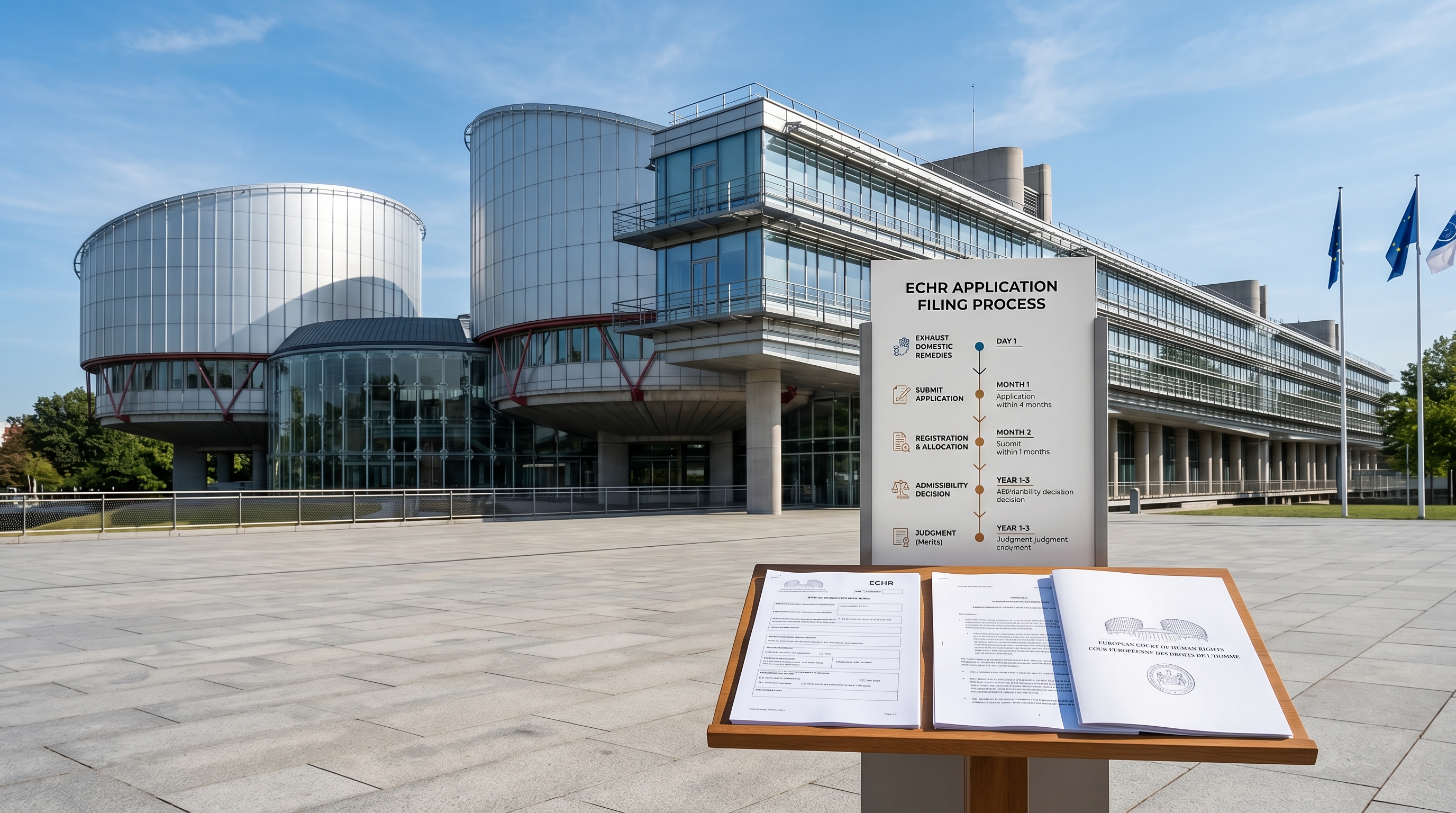
Step 1: Confirm that your case is admissible
Before you touch the application form, verify that your case meets all 12 admissibility conditions under Article 35. Most rejections happen at this stage. The critical ones: the four-month deadline has not expired, you have exhausted domestic remedies, the violation is against a Council of Europe member state, and your complaint engages a Convention right.
Do not assume that a domestic court error automatically equals an ECHR violation. The Court does not retry national cases. It examines whether the state violated a specific Convention right — not whether the domestic court got the law wrong. A factually compelling case can be legally inadmissible. Check our full ECHR admissibility criteria guide and use the admissibility checklist to go through each condition.
Step 2: Exhaust your domestic remedies
The Court requires you to have tried every effective remedy in your country before it will hear you. “Effective” means remedies with a realistic prospect of success — not every theoretical avenue the law provides.
For most cases, this means reaching the final national court (supreme court, constitutional court, or the relevant specialist court). For certain violations — unlawful detention under Article 5, excessive trial length under Article 6 — you may also need to use specific national compensation mechanisms. If your country has enacted a pilot-judgment procedure following a previous ECHR case, you may need to use that domestic remedy first.
Document everything. Keep the dates of each procedural step, the court decisions at each level, and the grounds you raised. The Court will ask for all of this. Missing documentation can result in inadmissibility for failure to exhaust.
Step 3: Check the four-month deadline
The four-month rule is absolute. Since 1 August 2022, you have four months from the date of the final domestic decision. The clock starts on that date — not on the date you receive the written judgment, not on the date you learn about it from a lawyer. There are no extensions.
Calculate the deadline immediately after the final domestic decision, before doing anything else. Write it down. Do not wait for translated documents or a legal aid decision before calculating — those processes cannot extend your deadline. See the ECHR time limit guide for special cases (ongoing violations, absence of domestic remedies).
Step 4: Complete the official application form
The Court only accepts the official application form (Form DOC), available from the Council of Europe website. Since January 2022, the Registry no longer accepts initial letters in lieu of the form. A letter describing your complaint will not stop the four-month clock.
The form requires: full personal details of the applicant and representative, the name of the respondent state, a clear statement of the facts in chronological order, the specific Convention articles you claim have been violated, confirmation that domestic remedies have been exhausted with dates and court names, and your declared compliance with the four-month rule.
The statement of facts is critical. It must be accurate, complete, and concise — ideally no longer than 20 pages. The Court reads thousands of applications. Long, disorganised descriptions are harder to process and more likely to trigger early rejection. Write in the first person, stick to facts, avoid legal argument at this stage.
Read the full requirements in our ECHR application form guide.
Step 5: Gather and prepare your documentation
Attach all key documents, in chronological order, without duplicates. Essential attachments: domestic court decisions at all levels (certified copies where available), correspondence with authorities, evidence of the facts, and any domestic compensation decisions. Do not send original documents — the Registry accepts copies. Organise them with a numbered index.
If documents are in a language other than English or French, you may submit them in their original language — but the application form itself must be in English or French. Translations of key passages help speed up processing, though they are not compulsory at this stage.
Step 6: Submit the application
Send the completed form and attachments by post or through the Court’s online submission system (ECHR Online). The Registry’s address: European Court of Human Rights, Council of Europe, F-67075 Strasbourg Cedex, France.
If submitting by post, the date of the postmark determines whether you filed in time — but you must send the complete, signed form. A fax or email does not count. If using ECHR Online, keep your submission reference number.
After submission, the Registry will acknowledge receipt and assign your case a number. This does not mean your case is accepted — it means it is in the queue for an initial admissibility check.
Step 7: Interim measures (if urgent)
If you face imminent and irreversible harm — deportation, extradition, risk of death or torture — you can apply to the Court under Rule 39 for an interim measure. This is an emergency request to suspend the act until the Court examines the case. Interim measures are granted in serious cases, but they are not automatic. The Court requires clear evidence of a real risk and irreversibility.
If interim measures are needed, file immediately — do not wait to complete the full application. Send a summary of your case, the specific risk, the date by which the act is scheduled, and any domestic decisions. The Registry has emergency procedures for urgent cases.
Step 8: Wait for the admissibility decision
After submission, a Registry lawyer will carry out an initial review. If the case appears inadmissible on its face, a single judge or a three-judge committee will reject it without hearing from the respondent state. This can take months or years, depending on the Court’s backlog.
If the case passes this initial filter, the Court will notify the respondent government and request observations. At this stage, you will have an opportunity to respond to the government’s submissions. Most cases stop here — either rejected as inadmissible, or declared admissible and referred to a Chamber for examination of the merits.
Should you file without a lawyer?
The Convention does not require legal representation at the admissibility stage. You can file yourself using the official form. But the error rate in unrepresented applications is significantly higher. A qualified ECHR lawyer will check the admissibility conditions, structure the statement of facts correctly, identify the right Convention articles, and advise on whether to file at all.
If the Court communicates the case to the government — meaning it passes the initial filter — legal representation becomes practically mandatory. The respondent government will be represented by its Agent and specialist lawyers. Arguing against a state without legal representation at that stage is not advisable.
You can review the full list of Convention articles and find country-specific guidance in our ECHR lawyer pages. If you need advice on whether your case is ready to file, describe your situation and we will assess it. Contact our ECHR lawyers.
At a glance
| Criterion | Requirement | Common pitfall |
|---|---|---|
| Exhaustion of domestic remedies | Use every effective national remedy first | Not raising the Convention argument nationally |
| Four-month time limit | Lodge within four months of the final decision | Miscalculating the start date |
| Victim status | Be directly and personally affected | Bringing an abstract complaint (actio popularis) |
| Not anonymous / not duplicate | Identify yourself; not already examined | Re-submitting the same matter |
| Not manifestly ill-founded | Show an arguable Convention breach | Unsubstantiated claims |
| Significant disadvantage | Show a real disadvantage was suffered | Trivial or minor claims |