The European Court of Human Rights rejects over 90% of applications without examining the merits. The reason is almost always the same: the application fails one of the admissibility conditions listed in Article 35 of the Convention. Before you file anything, work through each criterion below. Miss one, and your case is permanently closed.
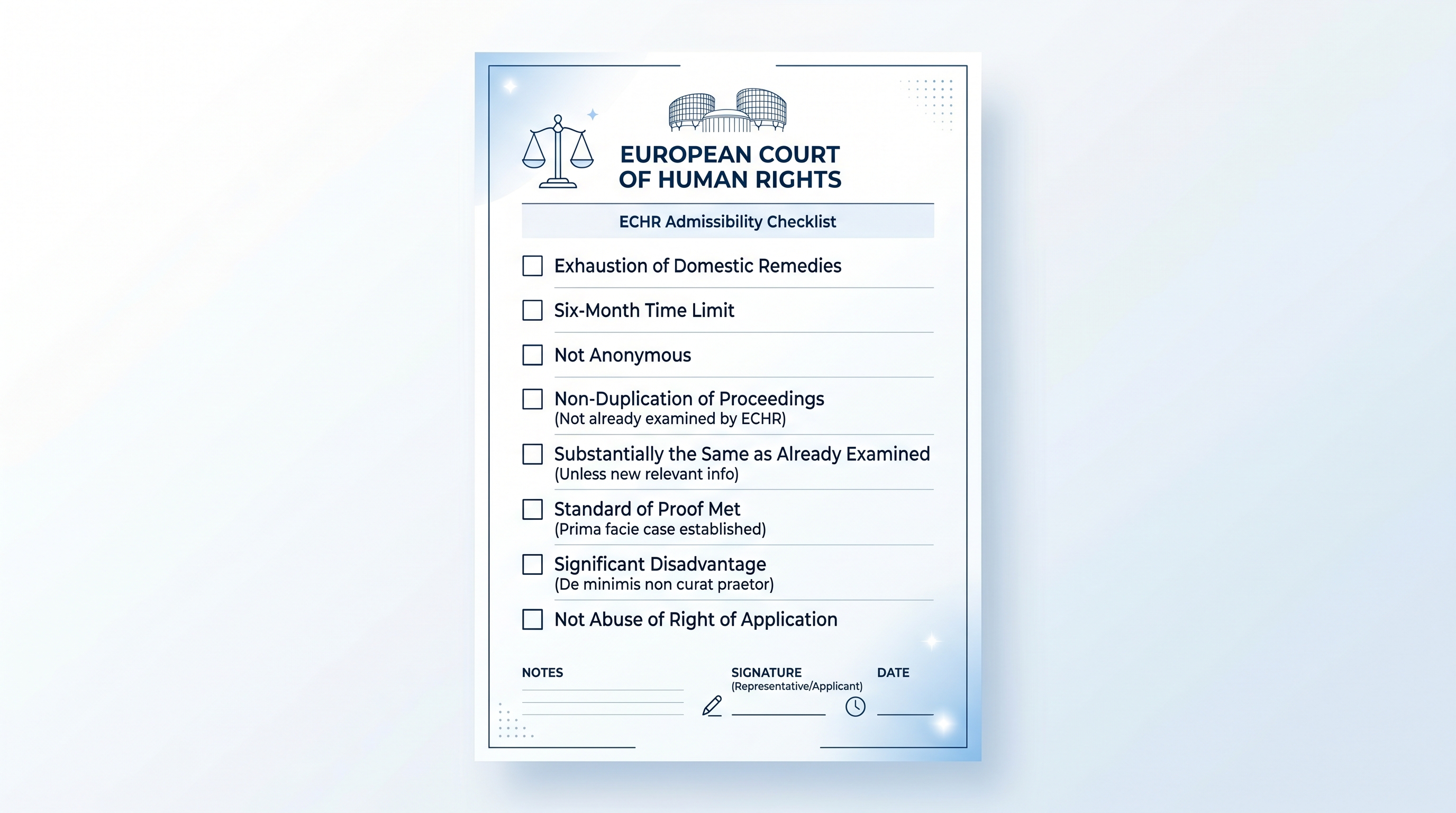
1. Four-month time limit
Since 1 August 2022, you have four months from the date of the final domestic decision to file with the Court. Protocol 15 changed this from six months, and the rule applies without exceptions or extensions. The clock starts on the decision date — not when you receive the written judgment, not when you hire a lawyer.
If the court sends you a written copy three weeks after pronouncing the decision, you have already lost three weeks. Private consultations, legal aid applications, and document gathering do not pause the deadline. The most common reason cases are rejected is this: applicants count from the wrong date. Count from the day the final domestic court ruled, not from the day you read the ruling.
Where there is no domestic remedy to exhaust — for example, in cases of an ongoing administrative practice — the four months run from the act or the date you first became aware of it.
2. Exhaustion of domestic remedies
You must use every effective remedy available in your country before turning to Strasbourg. The Court applies this rule strictly. If your legal system has a constitutional court, you generally need to go there. If a specific remedy exists for the type of violation you are complaining about — a compensation claim for unlawful detention, for example — you need to have used it.
The key word is “effective.” A remedy is ineffective if it has no realistic prospect of success given established domestic case law, or if it is purely discretionary. You are not required to pursue remedies that courts in your country have consistently rejected for identical complaints. But you need to demonstrate this — the Court will not accept your assessment without evidence.
If you skipped a domestic level because you thought it would be futile, that is not enough. You need to have tried and been refused, or to show clearly that the remedy does not function in practice, supported by case law or documented official practice.
3. Victim status
Only a “victim” of a Convention violation can apply. This means someone directly and personally affected by the act or omission in question. You cannot file a complaint about a law that might one day affect you, or represent a group without being personally harmed.
A state can remove your victim status by acknowledging the violation and providing adequate redress. If a domestic court has already found a breach and awarded compensation the Court considers sufficient, your standing is gone before you even file. Check this carefully — it catches many applicants off guard.
4. Respondent is a Council of Europe member state
Applications must be directed against one of the 46 states that have ratified the Convention. You cannot file against the EU, the UN, private companies, or individuals — only against states. If a state-owned company violated your rights, the application goes against the state, not the company.
Territorial jurisdiction matters. The violation must fall within the respondent state’s jurisdiction. For most cases this is straightforward. For extraditions, military operations abroad, or occupied territories, the analysis requires careful legal work.
5. The violation occurred after ratification (ratione temporis)
The Court cannot examine violations that happened before the respondent state ratified the Convention. Each state’s ratification date differs: Ukraine ratified on 11 September 1997, Turkey on 28 January 1954, Georgia on 20 May 1999. If the core facts of your case predate ratification, the Court has no jurisdiction.
Exception: continuous violations. If a situation started before ratification but is still ongoing — long-term detention, unresolved property confiscation, persistent administrative discrimination — the Court can examine the continuing aspect after the ratification date.
6. Not substantially the same as a case already examined
Once the Court has decided your case — even to declare it inadmissible — you cannot refile the same complaint with new arguments. This is final. The ban also covers parallel proceedings: if you have submitted the same complaint to the UN Human Rights Committee, the Inter-American Commission, or a comparable body, the Court may also declare your case inadmissible on this ground.
7. Application is not anonymous
Every applicant must be identified by name and a verified contact address. Anonymous applications are rejected without review. If you have genuine safety concerns — threats from authorities, risk of persecution — you can apply for a confidentiality order so your name is not published in public decisions. The Court regularly grants this. But you must still identify yourself to the Registry.
8. Not an abuse of the right of petition
The Court rejects applications that rely on false or misleading information, use offensive language, or are clearly designed to harass. Repeatedly refiling the same rejected application also qualifies. This ground is used rarely, but it is absolute when it applies.
9. Significant disadvantage
Protocol 14 introduced this condition in 2010. The Court can reject a technically valid complaint if the applicant has not suffered a significant disadvantage. Minor procedural errors with no real impact, trivial financial losses, or situations where domestic courts have already adequately addressed the matter tend to fail here.
Two safety nets apply: the Court will still accept a case if respect for human rights requires it, or if the domestic courts failed to examine the complaint properly. But in practice, if the harm is negligible, the application will not proceed to the merits.
10. Not manifestly ill-founded
This is the most frequently cited rejection ground. A case is manifestly ill-founded if it discloses no arguable violation — either because the facts do not support a breach, or because the legal argument has no prospect of success given existing case law. The Court does not accept that every injustice is a Convention violation. Check the Court’s jurisprudence on your specific article before filing.
11. Compatible with the Convention (ratione materiae)
The right you are invoking must be protected by the Convention or a Protocol your state has ratified. The right to a pension, the right to work, or the right to obtain a visa are not Convention rights in themselves. Rights under Optional Protocols — Protocol 1 on property, Protocol 4 on freedom of movement — only apply against states that have ratified the relevant Protocol.
12. No parallel international proceedings
If you have submitted the same matter to another international body while proceedings are still ongoing there, the Court may declare your case inadmissible. This is distinct from the “already examined” ground — it covers pending cases, not decided ones. Check whether you have active submissions to UN treaty bodies or regional human rights mechanisms before filing with the Court.
Before you file
Filing a defective application does not reset the four-month clock. Once the Court rejects an application as inadmissible, the same case cannot be refiled. The only second chance is a referral to the Grand Chamber — and that only applies to cases that passed admissibility.
Review the full ECHR admissibility criteria and check the applicable time limits for your situation. The next step after confirming admissibility is completing the application — see our step-by-step guide on how to apply to the ECHR and the ECHR application form requirements.
If you are uncertain whether your case satisfies all 12 conditions, describe your situation. We will give you an honest assessment within 24 hours. Contact our ECHR lawyers.
At a glance
| Criterion | Requirement | Common pitfall |
|---|---|---|
| Exhaustion of domestic remedies | Use every effective national remedy first | Not raising the Convention argument nationally |
| Four-month time limit | Lodge within four months of the final decision | Miscalculating the start date |
| Victim status | Be directly and personally affected | Bringing an abstract complaint (actio popularis) |
| Not anonymous / not duplicate | Identify yourself; not already examined | Re-submitting the same matter |
| Not manifestly ill-founded | Show an arguable Convention breach | Unsubstantiated claims |
| Significant disadvantage | Show a real disadvantage was suffered | Trivial or minor claims |